
Running a successful restaurant has always been challenging, but today’s landscape is even more demanding. More guests rely on reviews before visiting, costs fluctuate unexpectedly, and competition intensifies every day. How can any restaurant stay ahead and sustain profitability? The answer often lies in restaurant benchmarking, which involves comparing essential operational elements to industry standards. This approach helps pinpoint what truly drives success. Knowing how to measure performance and how those results compare can make all the difference for any hospitality business.
What is restaurant benchmarking?
Restaurant benchmarking involves evaluating outcomes across each segment of the operation and measuring them against other restaurants or accepted industry averages. This process allows managers to identify areas where the business excels and spots opportunities for improvement. It goes beyond checking monthly sales; it delves into financial metrics, customer satisfaction, cost tracking, and labor efficiency.
With effective benchmarks, data shifts from overwhelming spreadsheets to actionable steps. Directly comparing performance with competitors provides context for both challenges and strengths, simplifying goal setting and driving strategic decisions.
Why does benchmarking matter more than ever?
The hospitality sector is navigating tough times, marked by rising ingredient prices and new regulations impacting margins. Under these conditions, understanding exactly how every aspect of operations performs becomes crucial. Benchmarking is no longer reserved for large chains; independent restaurateurs need it just as much to remain viable and competitive.
No one benefits from guessing which part of an operation needs attention first. With benchmarking, decisions are guided by concrete evidence instead of intuition. For example, if labor costs exceed industry standards, targeted measures can be implemented to control expenses without compromising service quality.
Core areas to benchmark in a restaurant
Benchmarking spans everything from kitchen prep time to profit margins. Determining which metrics matter most will vary based on menu, location, and style, but several universal categories offer valuable insights.
- Financial metrics: food cost percentage, beverage cost percentage, average check size, net profit margin.
- Labor costs: total wages compared to revenue, productivity per hour, scheduling efficiency.
- Sales optimization: table turnover rates, upselling effectiveness, seasonal trends, marketing return on investment.
- Customer satisfaction: review scores, repeat patronage rates, complaint reduction, feedback trends.
- Operational performance: order accuracy, kitchen speed, waste levels, equipment downtime.
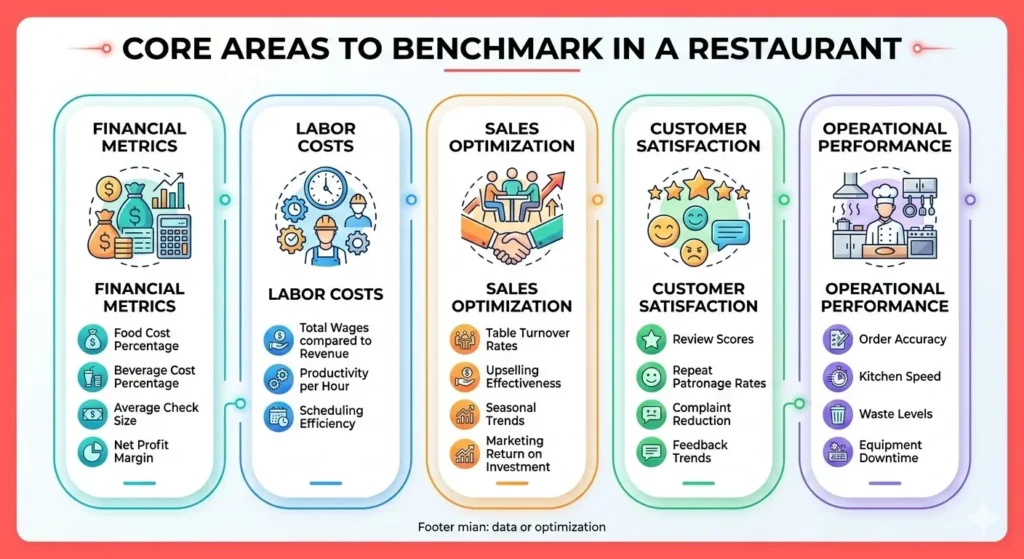
Concentrating on these key factors enables a business to address weaknesses quickly and adapt strategies, while maximizing advantages wherever they exist.
How to get started with benchmarking?
Beginning a benchmarking journey does not require expensive software or consultants. A few straightforward steps can point any restaurant toward continuous improvement and increased profitability.
First, it is important to clarify objectives and select relevant key performance indicators (KPIs). Next, gather reliable data from trusted internal sources and establish a routine for regular comparison with up-to-date industry standards. These foundational actions set the stage for meaningful change.
Set clear objectives and pick relevant KPIs
Success starts with defining which aspects deserve focus. Whether the aim is to boost profits, enhance service quality, or control food costs, each objective shapes the selection of KPIs. Common choices include gross profit margin, cost per cover, table occupancy rate, and guest wait times.
It is best to select KPIs that align with strategic goals, steering clear of metrics that look impressive but lack practical impact. Data related to cost tracking or positive review growth typically drive real improvement.
Gather reliable data and compare regularly
Consistency underpins every benchmarking effort. Reports should draw from accurate internal sources such as point-of-sale systems, employee schedules, inventory records, and customer surveys. Once collected, these figures must be compared with current industry standards for meaningful benchmarks.
Setting a fixed schedule—monthly or quarterly—for reviewing and updating results ensures benchmarks remain relevant. Frequent checks keep adjustments manageable and prevent issues from escalating unnoticed.
Common challenges when benchmarking
Despite its many benefits, restaurant benchmarking can present obstacles. Staff may resist new measurement routines, or owners might feel overwhelmed choosing among numerous KPIs. There is also a risk of overcomplicating processes and losing sight of day-to-day realities.
The key is to build sustainable habits rather than chasing quick wins. Focusing on two or three top priorities and making improvements visible to the whole team boosts morale and makes progress tangible, even during slower phases.
Turning data into profit-boosting actions
Raw numbers alone will not solve sluggish sales or mounting costs. The true value of benchmarking emerges when analysis guides decisive action. Identifying expense categories that surpass norms, or noticing declining loyalty among certain customer segments, enables prompt and effective responses.
For instance, if labor costs consistently exceed benchmarks, reviewing shift patterns, cross-training staff, or adjusting opening hours can help. If sales optimization lags, experimenting with new promotions or rethinking seating layouts may provide solutions. Ultimately, benchmarking serves as a launch pad for timely, smart adaptation.
Frequently asked questions about restaurant benchmarking
What are the most important KPIs for restaurant benchmarking?
Restaurants benefit most from tracking KPIs tied to financial stability, customer satisfaction, and operational efficiency. Key examples include:
- Net profit margin
- Food and beverage cost percentages
- Table turnover rate
- Average check size
- Loyalty and return visit rate
Selecting KPIs that reflect specific objectives leads to better comparisons and faster resolution of issues.
How often should a restaurant update its benchmarks?
Most restaurants achieve optimal results by reviewing benchmarks either monthly or quarterly. Adhering to a consistent schedule allows proactive adjustments instead of waiting for major problems to arise. High-volume establishments might even consider weekly snapshots for critical KPIs like sales or labor costs.
- Monthly or quarterly reporting suits most mid-size venues
- Fast-paced operations may opt for weekly tracking
Analyzing both short-term shifts and long-term patterns delivers clearer insights.
What tools help simplify restaurant benchmarking?
Some restaurants begin with spreadsheets or manual trackers, while others use point-of-sale systems, accounting software, or custom dashboards tailored to foodservice analysis. The ideal choice depends on budget, business size, and the technical comfort level of managers.
- Spreadsheets for small businesses
- Point-of-sale and scheduling platforms for integrated data capture
- Bespoke analytics dashboards for chain operators
Choose tools that ensure consistency and save time throughout the reporting cycle.
Can benchmarking help improve customer satisfaction ratings?
Tracking and comparing guest experience metrics highlights strengths worth replicating and recurring weak spots needing attention. By routinely reviewing review scores, wait times, and complaint ratios alongside industry standards, teams can craft more effective customer care strategies. Even minor adjustments, supported by solid data, can lead to significant improvements in satisfaction and loyalty.
- Monitor net promoter score (NPS)
- Track online review averages
- Analyze repeat visit data
| Metric | Industry standard |
|---|---|
| Table turn time | 45 minutes |
| NPS | 50+ |
| Online review average | 4.0/5.0 |