
How to negotiate better prices with restaurant suppliers
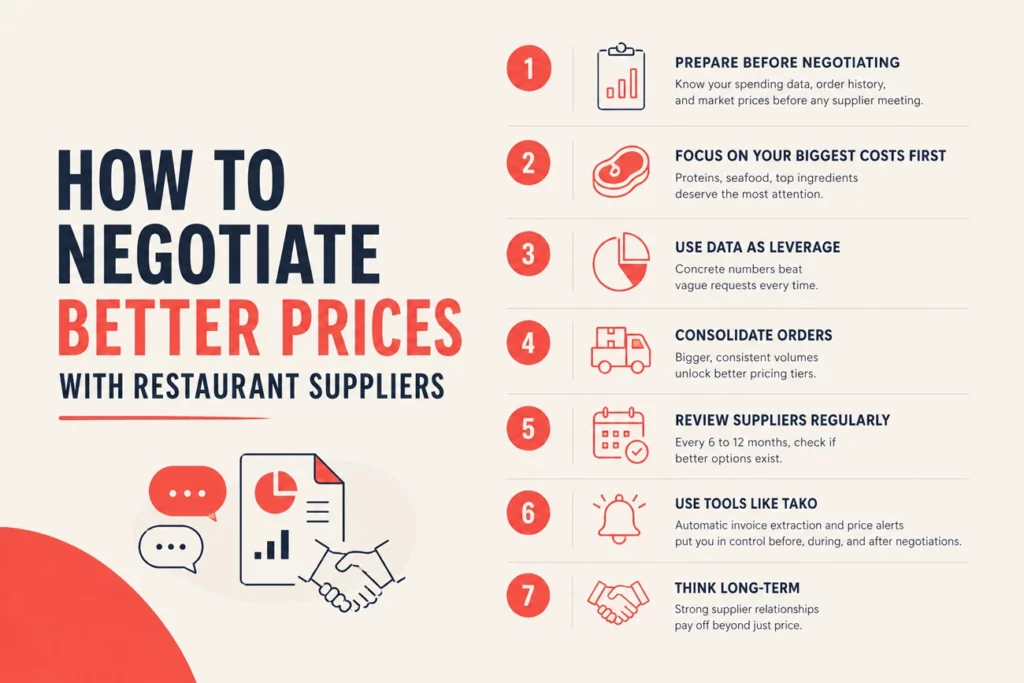
Seizing every opportunity to control costs is crucial for success in the restaurant industry. Establishing effective supplier/vendor relationships and partnerships ensures smooth daily operations, while a lack of strategy can cause expenses to spiral out of control. Embracing a smart approach to negotiating better prices and deals unlocks savings and helps keep the bottom line strong. The journey toward favorable outcomes begins with research, preparation, and open communication rather than simply haggling over a few cents per item.
Why strong supplier negotiations matter?
Developing proactive relationships with suppliers has an impact far beyond immediate cost savings. Effective negotiation shapes not just price, but also quality, reliability, delivery speed, and even access to specialty products or exclusive lines. It sets the tone for ongoing vendor interactions, fostering mutual trust instead of adversarial exchanges. Focusing solely on price may sometimes introduce risks like supply interruptions or inconsistent quality. True expertise involves balancing competitive pricing with long-term partnership benefits and stability.
The ability to negotiate better prices and deals often determines whether a restaurant thrives during challenging periods or struggles with thin margins. Supply costs from produce to cleaning supplies—typically form a significant portion of operating expenses. Every percentage point saved through skillful negotiation creates room for reinvestment in quality upgrades, staff development, or marketing initiatives.
Preparing for successful negotiations
Preparation is the foundation of effective negotiation. Approaching discussions with clear objectives and accurate data leads to more favorable terms than relying on aggressive tactics. Investing time in thorough groundwork before making requests or counteroffers pays off significantly.
A strong base includes researching suppliers and market options, ensuring full awareness of alternative providers, their pricing, and quality standards. Information holds power when paired with analytic tools or dashboards that track historical spending patterns and seasonal trends.
Researching suppliers and market options provides leverage
Compiling a list of potential vendors expands the possibilities at the negotiating table. Comparing not just base prices, but also value-added services such as free delivery, payment flexibility, or return policies, gives leverage. Benchmarking against current market rates signals knowledge and strengthens the case when requesting concessions.
Evaluating competing offers reinforces to vendors that loyalty must be earned, not assumed. Once suppliers understand there is willingness to switch suppliers or seek substitutes if necessary, they tend to offer their best available pricing upfront. Staying informed encourages suppliers to present their strongest proposals from the start.
Analyzing current usage, spend, and priorities
Tracking where the largest portions of the purchasing budget are spent highlights which categories deserve focused attention. Rather than spreading effort across countless items, many restaurateurs achieve more by concentrating on high-spend or top items first. If proteins or certain vegetables consume most of the monthly budget, these become prime candidates for targeted cost control and improved profitability.
Data-driven negotiation supported by invoices, order histories, and real-time consumption reports—transforms vague requests into precise proposals, making discussions more productive and fact-based.
- Gather all purchase records sorted by item or category.
- Highlight any trends in volume spikes, seasonality, or price changes.
- Identify top five items by total spend for focused discussion.
Establishing effective negotiation tactics
Approaching vendors with confidence and clarity transforms routine transactions into meaningful dialogue. Defining in advance what needs improvement such as unit pricing, minimum order size, or payment terms ensures no critical detail is overlooked. Negotiation works best as an ongoing process, not just a once-a-year event tied to contract renewal.
Exploring different angles during discussions prevents deadlock. Demonstrating flexibility and acknowledging vendor constraints can lead to creative solutions that benefit both parties, including bulk discounts or supplier-sponsored promotions.
How tools like Tako make supplier negotiations easier
One of the biggest challenges in supplier negotiations is having the right data at the right time. This is where a purpose-built solution like Tako Solutions gives restaurateurs a concrete edge. Tako automatically extracts and structures data from supplier invoices using AI, giving operators a real-time, centralized view of their spending by ingredient, category, or supplier, without any manual entry. When it is time to sit down with a vendor, there is no need to dig through stacks of invoices or rely on memory: the numbers are already organized, up to date, and ready to present. Price increase alerts notify you the moment a supplier adjusts their rates, so you can react quickly, whether that means renegotiating terms, switching to an alternative, or adjusting your menu margins accordingly. By transforming every invoice into actionable insight, Tako Solutions shifts the negotiation dynamic: instead of reacting to supplier proposals, you walk into every conversation with facts, history, and leverage.
Leveraging buying power to boost negotiation success
Restaurants gain significant bargaining advantages by pooling orders or consolidating purchases under fewer suppliers whenever possible. Offering higher guaranteed monthly volumes frequently prompts suppliers to provide preferred pricing tiers. Some establishments join informal buying groups with other operators to increase collective clout and unlock unique commercial terms unavailable to smaller clients acting alone.
For single locations, leveraging buying power means discussing projected order quantities openly and emphasizing consistency. Suppliers prefer reliable accounts and may reward them with access to limited products, reduced minimums, or priority scheduling.
Specifying or requesting desired terms respectfully
Clear communication about priorities yields better results. Instead of vaguely asking if something can be cheaper, using direct language to outline target prices, specific delivery schedules, or alternative packaging requests generates actionable responses.
Requesting tailored proposals places responsibility on the supplier to innovate or bundle offerings that meet requirements. Clarifying expectations such as quality specifications, cutoff deadlines, and payment methods prevents confusion later on.
- Send written summaries after meetings to confirm mutual understanding.
- Mention opportunities for ongoing collaboration if new needs arise.
- Frame negotiation as collaborative problem-solving rather than confrontation.
Maximizing savings without sacrificing quality
Maintaining high standards is just as important as securing impressive prices. Sometimes the lowest quote comes with hidden drawbacks, such as inconsistent product sizing or unreliable substitutions. Smart negotiators focus equally on quality, service, and supply chain reliability, ensuring that cost control does not undermine the guest experience.
Openly discussing the balance between budget and performance leads to mutually beneficial scenarios. Occasionally, adjusting ordering habits like accepting deliveries on alternate days or choosing seasonal alternatives reveals valuable efficiencies for both vendors and restaurants.

Switching suppliers or seeking substitutes strategically
No relationship should continue unchanged purely out of habit. Reviewing existing agreements on a regular schedule every six months or annually helps determine if other suppliers now offer superior value or innovative solutions worth exploring. Making respectful inquiries signals a commitment to optimizing procurement, not just saving pennies.
Seeking substitutes, such as regionally produced goods or alternative brands, demonstrates adaptability. Sometimes introducing a comparable product delivers savings with minimal disruption to recipes or presentation.
Focusing on high-spend or top items first
Targeting negotiations around major cost drivers usually produces the greatest return. For instance, if seafood makes up 35% of overall food costs, prioritizing those talks achieves more impactful results than renegotiating minor supplies. Segmenting efforts this way increases efficiency and keeps engagement meaningful for both restaurant teams and suppliers.
This approach often uncovers additional opportunities, such as optimizing inventory levels or jointly forecasting menu shifts to secure better rates before high-demand periods.
- Audit purchasing records quarterly for untapped opportunities.
- Rotate supplier reviews by product category throughout the year.
- Use usage data to justify special rates or early order commitments.
Long-term strategies for continuous improvement
Short-term wins are valuable, but sustained cost control relies on open communication and regular evaluation of supplier performance. Proactively checking in, sharing feedback, and updating partners on evolving needs reinforce shared goals. Trust grows over time with transparency and timely information exchange.
Restaurateurs enhance results by viewing negotiation as a cycle, not a one-off occurrence. Periodic evaluations benchmark progress and reveal which approaches work best for each vendor. This iterative mindset encourages suppliers to bring forward competitive offers throughout the year, rather than only when prompted.
Setting up routine reviews and check-ins
Regular meetings or calls allow both sides to revisit agreements, adjust based on changing demand, and resolve issues before escalation. Agendas might cover pricing updates, order accuracy, delivery timeliness, and forecasts for upcoming periods.
Implementing a structured review process shows professionalism and creates opportunities for incremental improvements. Jointly reviewing KPIs pinpoints strengths and allows collaborative correction of weaknesses.
Using data-driven negotiation for incremental gains
Modern purchasing departments increasingly rely on dashboards and analytics platforms to visualize trends, monitor contract expiration dates, and identify inconsistencies. Leveraging these technologies turns anecdotal evidence into measurable targets for improvement. Presenting concrete numbers empowers the restaurant team to request better terms confidently and back up proposals with facts.
Many suppliers appreciate receiving summary reports or shared metrics, which streamline decision-making and promote genuine partnership behavior.
- Generate regular summary statements highlighting spend concentration and variance versus plan.
- Create visual aids, such as simple tables, to clarify asks during renegotiation sessions.
- Track and celebrate savings achieved to motivate continued diligence.
Key questions about negotiating restaurant supplier prices
How can one use data-driven negotiation in restaurant supplier talks?
- Compile year-over-year spend and highlight growth potential.
- Compare pricing with competitors to create leverage.
- Pinpoint where costs have increased unexpectedly.
| Month | Total Spend ($) | Unit Price ($) |
|---|---|---|
| January | 5,000 | 6.50 |
| February | 4,800 | 6.30 |
| March | 5,200 | 6.60 |
Which negotiation tactics help secure better prices with suppliers?
- Leverage buying power by combining multiple orders.
- Ask for best available pricing directly.
- Share transparent order history to support requests.
- Be willing to discuss alternative products or timing.
When should restaurants consider switching suppliers or seeking substitutes?
- Review supplier mix and contracts twice yearly.
- Monitor market listings for emerging producers.
What steps help in specifying or requesting desired terms with suppliers?
- List non-negotiable terms prior to the meeting.
- Prepare written documentation to prevent misunderstandings.
- Conclude proposals with confirmation emails summarizing agreed details.