See which products just lost their margin
When an ingredient changes price, Tako lists every recipe that uses it and how far its cost has moved, so you know whether the croissant, the brioche or both need a new price.

A croissant is priced in cents, but its cost is decided by a handful of commodities: butter, flour, eggs, sugar, cocoa. When one of them moves, the margin on hundreds of products moves with it. Tako reads your mill, dairy and packaging invoices, follows every ingredient per kilo and recalculates the cost of each loaf, croissant and slice as soon as a new price arrives.
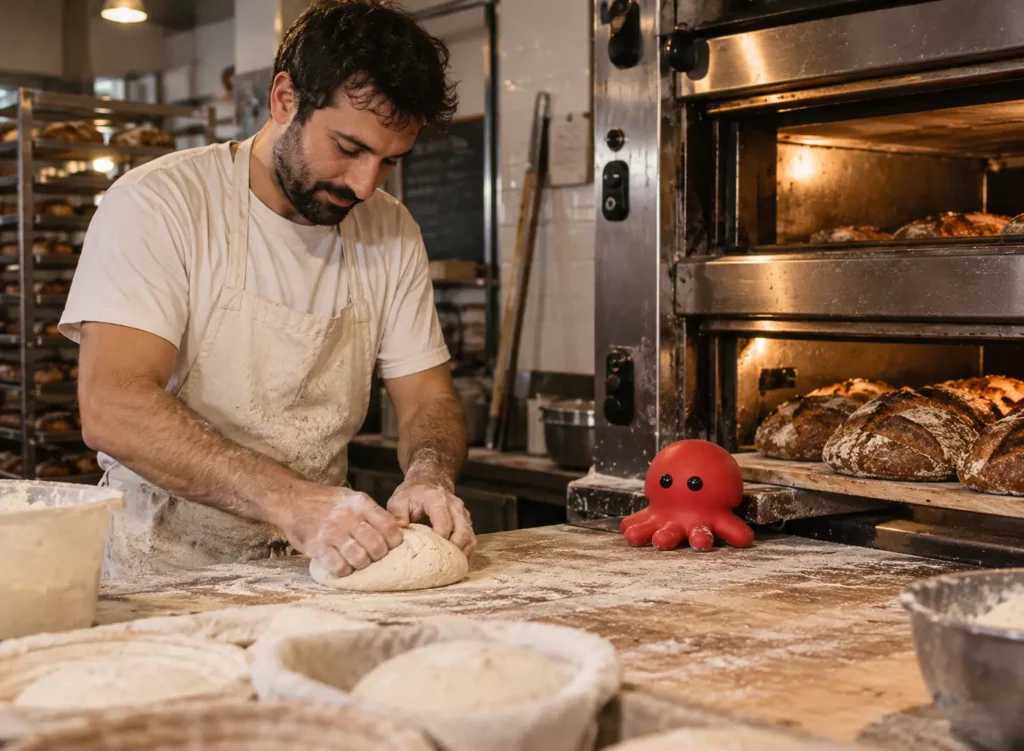
Photograph the invoice at the back door, upload the dairy’s PDF or send it on WhatsApp before the morning bake. Tako’s AI picks out every line, product, pack size and price, turns sacks and blocks into a price per kilo and feeds it straight into your recipes. Your bakery costing stays current without anyone retyping a single figure.

Sacks of flour, blocks of butter, trays of eggs, cake boxes: each line is extracted, checked against the printed total and filed under its supplier, ready to find again when a delivery is disputed.

Every ingredient keeps its own price history. When a supplier raises the price of butter or chocolate, you are alerted in the app and on WhatsApp, and you can compare the same flour across millers, per kilo.

Set up a croissant dough, a crème pâtissière or a levain as sub-recipes, enter the batch yield in kilos or pieces and the expected loss, and Tako works out the real cost of one viennoiserie or one slice.

A weekly spend summary, an alert when a dairy or flour price jumps, and a heads-up when an order looks unusually large. Read it at 4 a.m., no login needed.
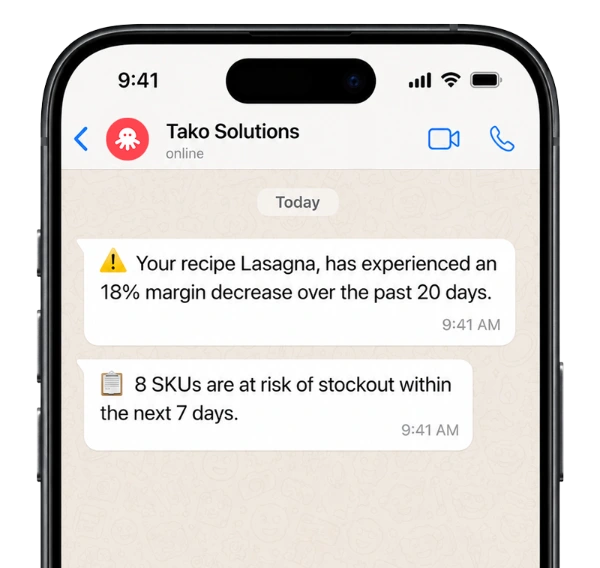

Bakeries sell many small items at fixed shelf prices, and the same butter, flour and eggs end up in nearly all of them. A sharp rise in butter does not show up as one big loss: it hides in every croissant, pain au chocolat and tart until the month-end figures land. A common rule of thumb is to keep ingredients around a third of the selling price or less, but you can only hold that line if your recipe costs move at the speed of your deliveries, not at the speed of a spreadsheet.
Once your recipes are in Tako, each product shows its ingredient cost, its margin at your selling price and the share of that price taken by ingredients. Try a new price for your baguette or a smaller format in the margin simulator before you change the label in the shop.
Enter the recipe for the whole batch, including sub-recipes such as the laminated dough, then set how many pieces or kilos it yields and the expected loss. Tako divides the batch cost by the yield and gives you the cost per piece, updated with every new ingredient price.
Yes. Each stage can be its own sub-recipe and be reused across products. When the price of butter changes, every product built on that dough is recalculated.
As soon as the invoice with the new price is read, Tako updates the ingredient, recalculates the recipes that use it and alerts you in the app and on WhatsApp, so you can decide whether to change a price or a supplier.
No. Tako doesn’t handle sales or the till. It focuses on what you buy and what your products cost, and sits alongside the tools you already use.
Yes, for one bakery: invoice reading, ingredient price tracking and recipe costing are included, with no time limit. If you run several shops, the multi-site app can be added monthly, without commitment.